 |
|
The following names have a territorial association with the Lindsay family.
The names Byres, Byars, Byers, Byre, Bier(s) and Buyers are derived from the old barony of Byres in Haddingtonshire (now East Lothian). This barony was held by the Lindsay family from 1233 and gave name to the title 'Lindsay of The Byres', which is still used by a cadet branch of the family.
Byres is a topographical name derived from Old English býre, meaning stall or cattle shed.
The surname is recorded in ancient usage. In 1309 John de Byres was a monk in Neubotle, Edinburghshire. Thome de Byris was the owner of a tenement in Edinburgh in 1392. In 1534, there is a record of a Thomas Byrs being a burgess of Aberdeen. George Byris and Thomas Byris were successively ministers of Legertwood (north-east of Earlston) in Berwickshire from 1593 to 1653. John Byres was a well-known merchant in Edinburgh who died in 1639. In 1690 the schoolmaster at Melrose was Thomas Byers. Andrew Byres was a burgess of Cupar in 1694.
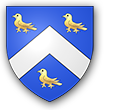 The
family of Patrick Byres of Tonley is recorded as descending from John Byres,
a merchant of Edinburgh in 1610. Patrick was granted a coat of arms by Lord
Lyon in 1755. These arms show a blue shield on which is a silver chevron between
three golden swallows. Patrick's son, James, lived in Rome for many years and
became a well-known antiquarian. The family lived on their estate of Tonley,
in Aberdeenshire, until the 1950s.
The
family of Patrick Byres of Tonley is recorded as descending from John Byres,
a merchant of Edinburgh in 1610. Patrick was granted a coat of arms by Lord
Lyon in 1755. These arms show a blue shield on which is a silver chevron between
three golden swallows. Patrick's son, James, lived in Rome for many years and
became a well-known antiquarian. The family lived on their estate of Tonley,
in Aberdeenshire, until the 1950s.
Cobb is a common name in the Brechin area – two-thirds of the county was held by the Lindsays, and the area became known as the Land of the Lindsays. Malcolm Cob of Brechin owned land there in 1508, and John Cobb was known in Brechin in 1629. In 1528 there was a record of a place named Cobbisland in Brechin. A family by the name of Cobb helped pay for the building of a bell house at Novar in 1773 (10 km north-east of Dingwall).
Cobb is a topographical name derived from Old English cobb, meaning 'a rounded mass'.
The name Crawford is now 80th in the order of frequency of surnames in Scotland. This is a habitation name from any of the various places so called from the Old English cráwa (crow) and ford (ford).
According to 17th-century historian George Crawfurd, the Crawfords descend from Thorlongus (Thor the Tall), an Anglo-Danish chieftain who received a grant of land in Ednam, Scotland from King Edgar in about 1100 CE. His descendant, John of Crawford, was given or inherited lands near Crawford which thereafter were known as Crawfordjohn. The Crawfords continued to live in Crawfordjohn, adjacent to the Lindsay's barony of Crawford; a branch of these Crawfords settled in Ayr.
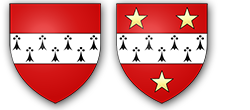 While more than fifty coats of arms are associated with the Crawfords, they
are generally variations on three themes.
Simple red arms with an ermine band across the middle (Gules
a Fess ermine) are associated with the Crawfordjohn family. These arms are
displayed in the Bute Mazer, a bowl which dates back to the 1320s. A silver shield showing a Stag's head is the coat of arms associated
with a junior branch of the Crawfords, the Dalmagrengan Crawfords of Nithsdale, descendants of
Sir Gregan who reportedly rescued King David I from a stag's attack in 1127.
The third design of Crawford arms is associated with Auchenames and shows crossed lances between ermine spots on a silver shield. This line ended when clan chief Hugh Ronald
George Craufurd sold all the estates in his possession in 1904 before moving to
Canada. He died in 1942 without a male heir.
While more than fifty coats of arms are associated with the Crawfords, they
are generally variations on three themes.
Simple red arms with an ermine band across the middle (Gules
a Fess ermine) are associated with the Crawfordjohn family. These arms are
displayed in the Bute Mazer, a bowl which dates back to the 1320s. A silver shield showing a Stag's head is the coat of arms associated
with a junior branch of the Crawfords, the Dalmagrengan Crawfords of Nithsdale, descendants of
Sir Gregan who reportedly rescued King David I from a stag's attack in 1127.
The third design of Crawford arms is associated with Auchenames and shows crossed lances between ermine spots on a silver shield. This line ended when clan chief Hugh Ronald
George Craufurd sold all the estates in his possession in 1904 before moving to
Canada. He died in 1942 without a male heir.
Presently there is no Crawford Chief. Peter Craufurd of Craufurdland petitioned the Lyon Court in October 2007 for Chiefship of this name, but there may well be other claimants, among them Sir Robert Crauford, Bt.
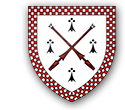 The present senior branch of the family, the Crawfords of Kilburney, Stirling received
a baronetcy in 1781, and are now represented by Sir Robert James Crauford, the
9th Baronet, who lives in Hampshire. His arms display two
crossed lances between four ermine spots on a silver shield, surrounded by a checked border.
The present senior branch of the family, the Crawfords of Kilburney, Stirling received
a baronetcy in 1781, and are now represented by Sir Robert James Crauford, the
9th Baronet, who lives in Hampshire. His arms display two
crossed lances between four ermine spots on a silver shield, surrounded by a checked border.
An earlier and distinct Kilbirnie title was inherited by the Lindsays. Margaret, the only daughter of Sir John Crawford of Kilbirnie, married the Hon. Patrick Lindsay in 1664. To inherit the lordship of Kilbirnie, Patrick (the second son of John, the 17th Earl of Crawford) changed his surname to Crawford. His grandson, however, re-introduced Lindsay into his surname; his son, George, was known as Lindsay-Crawford. George Lindsay-Crawford became 21st Earl of Crawford and Lord Kilbirnie. When Kilbirnie Castle burnt down in April 1757, George built a new home in Fife called "Crawford Lodge". There are no other recorded marriages between the Crawfords and the Lindsays.
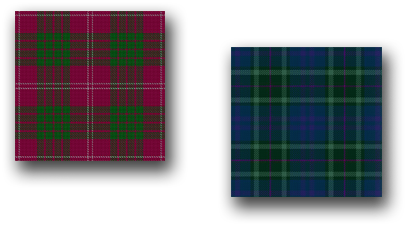
The Crawford tartan (left) is derived from the Vestiarium Scoticum, first published in 1842. A personal tartan for the Baron of Crawfordjohn (right) was designed in 2005.
For further details on the house of Crawford, or to join the Clan Crawford Association, visit clancrawfordassoc.org.
The names Deuchar and Deuchars come from the lands of Deuchar in Forfarshire (13 km west of Brechin). Dewar and Deuchar are both 'locality names', although Deuchar can also be an occupational name or nickname. Deuchar and Dewar were often interchanged in the past when spelling was not as consistent as it is now.
In Gaelic deoradh means pilgrim or stranger and was also a term for someone who had custody of the relics of a saint: a Perthshire family of this name were for centuries custodians of the crozier-head of St Fillan. There are two places called Dewar in Midlothian which would provide local surnames: Thomas and Peires de Deware did homage to Edward I of England in 1296. Dewar is the family name of the barons Forteviot, and has become synonymous in Perth with the manufacture of whisky. Dewar has also given rise to a Mac name: the Skye family of Mac gille dheoradha (son of the Dewar’s lad) simplified their surname to MacLeora, sometimes spelt MacClure.
The Deuchars of that Ilk were one of the oldest families in that area and
held lands of Deuchar in the parish of Fern from about 1230. The Deuchars
were first vassals of the Mowats and secondly of the Lindsays. In 1369 Sir
Alexander Lindsay of Glenesk granted a charter of the lands of Deuchar to
William de Deuhqwhyr. In 1819 the lands were sold and the owner left
Scotland.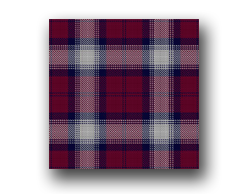
In 1478 Duchar of that Ilk assisted in the resolution of a dispute between neighbours. In 1569 Robert Dewquhir was a friar in Culross (11 km south-east of Alloa). John Dwichair was a shoemaker in Aberdeen in 1581. Alexander Dochar was a writer in Edinburgh in 1686.
Crawfords, Deuchars and Fotheringhams sometimes wear a variation of the Lindsay clan dress tartan.
The possible sources for the name Downie all indicate the earlier pronunciation 'doonie'. Ó Dúnadhaigh means 'fortress-keeper' and gave rise to the Irish version of the name. O Duibhne, legendary founder of the clan Campbell, is mentioned in the 11th century Book of Deer. In Scotland, there was a barony of Downie or Duny in Monikie parish near Dundee (dun meaning hill or fortress) which gave the common local surname of Downie. The name occurs sparsely in the early records (in Arbroath, Angushire, Dundee, Aberdeen, Glasgow and the Orkneys), but is now widely spread.
The barony of Downie was acquired by the Lindsays on the marriage of Sir David Lindsay in 1324 to Maria Abernethy.
Downey is an Australian First Fleet surname.
This Scots surname is derived from a place in Angus called ffodryngay in 1261; it was named after Fotheringhay, an estate in Northamptonshire. The name, which acquired the characteristically English suffix of –ingham, is derived from Old English fód-ring-ēg meaning 'island used for foddering or grazing'.
The estate of Fotheringham was held by the Scottish royal family in the 12th century as part of the honour of Huntingdon. When the Earl of Huntingdon became King David II and returned to Scotland in 1357 he looked kindly upon his former English neighbours; Henry de Fodringhay was in due course given land near Dundee, and his collaterals and descendants acquired further territories in Forfarshire and elsewhere. Thomas Fotheringhame was provost of Dundee in 1454; the estate of Fotheringham near Forfar is still in the family. The name travelled to other parts of Scotland, including Orkney, and is now common in Glasgow as well as in Angus.
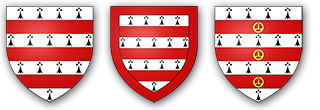
The arms of David Fotheringham (13th) of Powrie, and his relations Thomas Fotheringham of Bandean and Robert Fotheringham of Lawhill are recorded in the Lyon Office register. The first coat of arms has a shield of ermine with three red bars; the second is differenced with a red border; and the third is differenced with a golden buckle upon each bar.
Over several generations Fotheringham of Powrie was one of the Councillors to successive Earls of Crawford. A number of marriages have taken place between the Fotheringhams and Lindsays. Catherine daughter of Sir Thomas Fotheringham (3rd) of Powrie married c1480 Sir David Lindsay of Beaufort and Edzell. Thomas Fotheringham (8th) of Powrie married in 1555 Helen, daughter of John Lindsay, 5th Lord Lindsay of The Byres. And Jean daughter of Thomas Fortheringham (10th) of Powrie married in 1658 Sir Alexander Lindsay, 1st Baronet of Evelick.
Rinn in Gaelic (pronounced 'reen') means 'sharp point', and is a common place-name element with the sense of 'promontory'. Rhind is the
name of a farm near Fife, and there is a parish of Rhynd near Perth; the former
is probably the referent for Hugh del Rynd, who was a cleric of Bishop William
Lamberton of St Andrews in the early 13th century; and there are
numerous individuals in the early records whose names refer to the Perth Rhynd.
The surname spread widely after this: William Rinde appears in Edinburgh in
1426 and Henry Rynde in Caithness a year or two later; William Rynd was rector prebend
of Arbuthnot in 1548; John Rind was in Elgin in 1661. Alexander Rhind,
 Egyptologist
and expert on Theban tombs, in 1874 founded the ongoing Rhind lectureship in archaeology with the Society of Antiquaries of Scotland.
Egyptologist
and expert on Theban tombs, in 1874 founded the ongoing Rhind lectureship in archaeology with the Society of Antiquaries of Scotland.
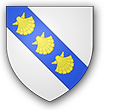
In 1672 Lord Lyon granted a coat of arms to Alexander Rind of Carse, Scotland, a "procuruer in Amsterdam in ye Province of Holland". These arms show, on a silver shield, three golden scallop shells upon a diagonal blue band.
The surnames Summer(s), Symmers, Symers, Simmers and Somers are metonymics which derive from the old occupation of sumpter or pack horse driver (from Old French sommier, sommetier, meaning 'pack horse').
William Sumer is recorded in connection with the hospice of Soutrain in the early 13th century. Johannes Sovmer was a burgess of Perth in 1365, and Adam Summer (heir to Barthillomew Summyr) lived in Glasgow in the mid-16th century. David Sommer was in Ancrum in 1633 and John Symer was a burgess of Aberdeen about the same time. A family named Symmer who held their Angus lands from 1450 to 1750 are said to have changed their name to Seymour. In 1682 the Symmers of Baljordie were known as an ancient family and chief of that name. There was an Elizabeth Summer in Stonehouse in 1698 (8 km south-south east of Hamilton).
Summers is an Australian First Fleet surname.
There is little evidence to support any Scots Gaelic derivation of the name Affleck from achadh-laec 'field of flat stones' as has been suggested from time to time. This surname is most likely of twofold origin: firstly, from the barony of Auchenleck in Ayrshire; and secondly, from Auchenleck in Forfarshire. The overriding ownership of the castle of Auchenleck in Ayrshire resided with the Lindsays; David Lindsay, the 5th Earl of Crawford had reconfirmed the marches (borders) of Auchenleck in 1459.
The earliest recorded ancestor of the Afflecks in Forfarshire was Johannes de Aghelek who paid homage to King Edward I in 1304. These Afflecks were hereditary armour-bearers to the Earls of Crawford, possibly from the time that the Lindsays acquired Finhavon Castle in Forfarshire (Angus) in 1375. This Affleck family, Auchenleck of Auchenleck, used as their coat of arms alternating horizontal silver and black bars.
There are several Afflecks of particular interest. Lord Auchinleck took his title from the family estate in Ayrshire. There
was a Patrick de Aghleke in Lanarkshire in 1296. Auchenleck barely survives
as a current surname in Scotland, although it is remembered as  that
of a famous World War II general. The surname Affleck appears mainly in the Borders
and Aberdeenshire; there are villages named Affleck in Lanarkshire and near
Dundee. James MacVicar Affleck of Edinghame, a surgeon on the island of Jamaica,
combined his Affleck coat of arms (known in heraldry as quartering) with those of MacVicar in December 1777. The Affleck of Edinghame
coat of arms is a silver shield with three black bars within a red border.
that
of a famous World War II general. The surname Affleck appears mainly in the Borders
and Aberdeenshire; there are villages named Affleck in Lanarkshire and near
Dundee. James MacVicar Affleck of Edinghame, a surgeon on the island of Jamaica,
combined his Affleck coat of arms (known in heraldry as quartering) with those of MacVicar in December 1777. The Affleck of Edinghame
coat of arms is a silver shield with three black bars within a red border.
Translate this page using Google Translate